
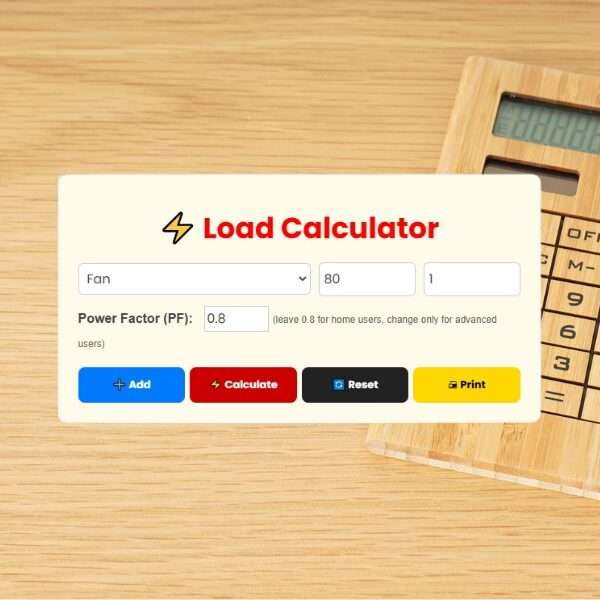
Load Calculator is the single most indispensable tool in today’s electrically driven world for understanding and planning power demand. Whether you’re upgrading an older home, designing a solar installation, or sizing an emergency generator for a commercial building, the consequences of miscalculating electrical needs can range from nuisance tripping of breakers to catastrophic equipment failure. Mastering the Load Calculator is the fundamental first step toward achieving electrical safety, efficiency, and system reliability.
The truth is, many professionals and homeowners rely on rough estimates or outdated rules of thumb, but precise power demand planning requires a structured approach. A detailed Load Calculator provides that structure, translating complex factors like power factor, duty cycle, and simultaneous operation into a clear, actionable total amperage or wattage requirement.
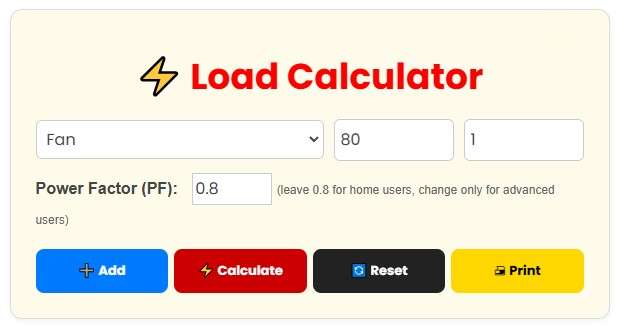
Why Every Project Needs a Reliable Load Calculator
A Load Calculator is more than just an adding machine; it’s a predictive modeling tool for your electrical system. It accounts for the difference between nameplate ratings (the maximum power a device could draw) and actual, real-world operating loads. Ignoring this distinction can lead to dangerous over-capacity or costly under-capacity scenarios. The ability to model these loads accurately is the primary value proposition of a modern Load Calculator.
1. Ensuring Safety and Code Compliance
The most crucial function of an accurate Load Calculator is to safeguard your property and its occupants. Overloaded circuits are the leading cause of electrical fires and component burnout. By providing a precise summation of current demands, the Load Calculator ensures that:
- Wiring is correctly sized for the anticipated continuous load, preventing overheating.
- Breakers and protective devices are appropriately rated to interrupt current safely during a fault or overload.
- The total demand does not exceed the capacity of the main utility service entrance.
Furthermore, electrical codes like the National Electrical Code (NEC) in the United States mandate specific demand factors and diversity factors for different types of circuits (e.g., general lighting, appliance loads, HVAC). A professional-grade Load Calculator incorporates these rules automatically, guaranteeing your design meets legal and insurance requirements. Without a thorough electrical Load Calculator, compliance becomes a guessing game—one with severe consequences.
2. Maximizing Cost Efficiency and Resource Allocation
Under-sizing an electrical system is clearly a risk, but oversizing is a financial drain. Many people believe “bigger is better” when selecting generators, transformers, or main panels. However, an oversized component can:
- Increase Capital Expenditure: A 400A panel is significantly more expensive than a 200A panel, and a 50 kVA generator costs far more than a 30 kVA unit. An accurate Load Calculator identifies the true peak demand, preventing unnecessary purchases.
- Reduce Operational Efficiency: Generators, for instance, are designed to run most efficiently when loaded between 50% and 75% of their capacity. An oversized generator running consistently at 20% load burns excess fuel, increases wear, and can suffer from “wet stacking” (unburnt fuel and oil residue), requiring more maintenance.
- Incur Penalties from Utilities: In commercial settings, peak demand charges are levied based on the highest power draw recorded during a billing cycle. By using a Load Calculator to strategically plan load-shedding or sequencing, businesses can flatten their demand curve and significantly reduce utility costs. A proactive use of the Load Calculator is essentially a long-term investment strategy.
5 Essential Steps of a Comprehensive Load Calculator
The process of accurately calculating your electrical load is methodical. While the specific inputs vary by project type (residential, commercial, industrial), a reliable Load Calculator follows these five fundamental steps to arrive at a definitive total requirement.
Step 1: Inventory All Electrical Loads (Nameplate Data)
The first step in any Electrical Load Calculation is a rigorous inventory. This requires gathering the nameplate data—the sticker or engraved plate found on every electrical device—for every component that will be connected to the circuit.
Required Data Points for the Load Calculator:
- Wattage (W) or Horsepower (HP): The primary measure of power consumption.
- Voltage (V): The operating voltage (e.g., 120V, 240V, 480V).
- Amperage (A): The maximum current draw.
- Phase: Single-phase or three-phase.
- Duty Cycle: Is the load continuous (running for three hours or more, like a server) or non-continuous (like a microwave)?
For new construction, this involves reviewing fixture schedules and equipment specifications. For existing structures, it means a physical audit of all appliances, lighting, and machinery. This initial data dump is the foundation of the entire Load Calculator process.
Step 2: Determine Continuous vs. Non-Continuous Loads
The NEC defines a continuous load as any load where the maximum current is expected to continue for three hours or more. This distinction is vital because the circuit components (wiring, breakers, switches) must be rated to handle 125% of the continuous load.
- Continuous Loads (125% Rule): HVAC systems, server racks, lighting in commercial buildings, heating elements. These loads must be multiplied by 1.25 in the Load Calculator.
- Non-Continuous Loads (100% Rule): Microwave, toaster, garage disposal, tools. These are calculated at their nameplate rating.
Correctly classifying loads dramatically affects the final required capacity and ensures the system operates safely under prolonged stress.
Step 3: Apply Demand and Diversity Factors
This is where the manual spreadsheet approach fails and a specialized Load Calculator shines. Few systems ever run at 100% capacity simultaneously. Demand factors and diversity factors are code-mandated percentages that account for realistic usage patterns:
- Demand Factor: Used for general purpose loads (like lighting or general receptacles). For example, the NEC allows you to calculate only a percentage of the total lighting load as the actual demand.
- Diversity Factor: Used primarily for large installations (like apartment complexes). It recognizes that not every apartment will run their oven, washing machine, and AC at the exact same moment.
Accurate application of these factors by a sophisticated Load Calculator prevents massive and unnecessary oversizing while maintaining safety margins.
Step 4: Calculate Sub-Totals and Convert to Amperage
After classifying loads and applying factors, the Load Calculator performs the core mathematical conversions. Since most distribution systems are rated in Amps, all power inputs (Watts, kVA, or HP) must be converted back to their required current draw using Ohm’s Law and its derivatives:
- Single-Phase: Amps=Volts×Power FactorWatts
- Three-Phase: Amps=Volts×3×Power FactorWatts
The Load Calculator processes these sub-totals for each branch circuit or phase (in three-phase systems). It calculates the peak demand for individual circuits before summing them up to arrive at the total required current for the main service entrance.
Step 5: Determine Peak Design Load and System Sizing
The final output of the Load Calculator is the Peak Design Load (in Amps or Watts). This figure is the maximum current the system is expected to handle under the worst-case scenario. This final number dictates the minimum ratings for all major components:
- Main Service Panel Size: Must be rated equal to or greater than the peak load.
- Transformer Size: Must match the peak kVA requirement.
- Generator Size: Must be capable of handling the continuous load plus the maximum starting current (inrush) of the largest motor or appliance. This step alone justifies the use of a specialized Load Calculator.
The Math Behind the Load Calculator: kVA, Amps, and Power Factor
While the concept is simple, the underlying math ensures precision. The Load Calculator must reconcile the difference between three key metrics to deliver an accurate result:
| Metric | Symbol | Unit | Description |
|---|---|---|---|
| Real Power | P | Watts (W) | The actual power consumed or converted into work (e.g., heat, motion). |
| Apparent Power | S | Volt-Amperes (VA) or kVA | The total power supplied by the source; the vector sum of Real and Reactive Power. |
| Current | I | Amps (A) | The flow of electrical charge. This is what heats wires and trips breakers. |
The relationship is governed by the Power Factor (PF), where Real Power=Apparent Power×PF. Inductive loads (like motors and compressors) reduce the PF, meaning you need to supply more current (Amps) to achieve the same useful work (Watts). A robust Load Calculator integrates the Power Factor for every inductive load to prevent a dangerously misleading low total current estimate.
Understanding Inrush Current
Another complex calculation handled by the Load Calculator is Inrush Current (or LRA, Locked Rotor Amps). Motors, compressors, and certain inductive equipment draw a massive surge of current (sometimes 6 to 10 times the running current) for a fraction of a second when they first start. While this current is momentary, the Load Calculator must ensure the selected generator or power source can momentarily provide this surge without stalling or experiencing a severe voltage dip. This is often the single most challenging calculation in generator sizing and highlights why a simple summation of running amps is inadequate.
For more in-depth formulas on calculating three-phase power, refer to the [Internal Link: Power Calculations Guide].
Beyond the Basics: Advanced Load Calculator Applications
The usefulness of the Load Calculator extends far beyond simply sizing a breaker panel. Modern electrical planning, especially in the context of sustainability and grid independence, relies heavily on this precision tool.
Integrated Renewable Energy Systems
When integrating solar panels or battery storage (like a Tesla Powerwall), the Load Calculator serves a dual purpose:
- Determining Battery/Inverter Size: It identifies the peak demand the inverter must meet, ensuring the battery system can deliver enough surge power to start major appliances.
- Optimizing Solar Array Size: By accurately calculating the home’s average daily energy consumption (kWh/day), the Load Calculator dictates the precise number of solar panels needed to achieve net-zero energy use, avoiding costly over-installation.
Commercial Peak Demand Management
In large commercial buildings, the Load Calculator becomes a powerful management tool. By precisely mapping when peak loads occur (e.g., 9:00 AM when all computers start, 12:00 PM when the kitchen is fully operational, 3:00 PM when HVAC cooling peaks), managers can implement:
- Load Shedding Strategies: Automatically turning off non-critical loads (like water heaters or exterior lighting) during the predictable peak demand times to save money.
- Phase Balancing: Ensuring that three-phase power is distributed equally across all phases, which improves efficiency and extends the life of the three-phase transformer and the source equipment, a key feature in an advanced Load Calculator.
Choosing the Right Load Calculator Tool
Given the complexity and the high stakes involved in electrical sizing, selecting the right Load Calculator is crucial. Avoid generic online tools that only ask for Wattage and Voltage. Look for a tool that asks for:
- Continuous vs. Non-Continuous designation.
- Power Factor or equipment type (to infer PF).
- The ability to specify three-phase inputs.
- A built-in safety margin multiplier (typically 125%).
A well-designed Load Calculator will not only provide a number but will also offer a detailed report breaking down the calculations for inspection and verification. This transparency is vital for accountability in any electrical project.
The advent of digital tools has streamlined this process significantly, making sophisticated calculations accessible to both electrical contractors and knowledgeable DIY homeowners. Utilizing a specialized Load Calculator is no longer a luxury—it is a mandatory step in responsible power planning.
To explore more about the professional standards for electrical design, you can visit the National Electrical Code (NEC) Website. Implementing the findings of your Load Calculator correctly is the final piece of the puzzle, ensuring your system runs safely, efficiently, and reliably for decades to come. Don’t leave your power future to chance—start with a precise Load Calculator today.





Just filled out that formg28! It was surprisingly straightforward. Makes things so much easier. Give it a try formg28 if you need it.